How I Create a Calm & Connected Circle Time
Ideas for creating a familiar circle time rhythm through songs, movement, children’s choices and storytelling.
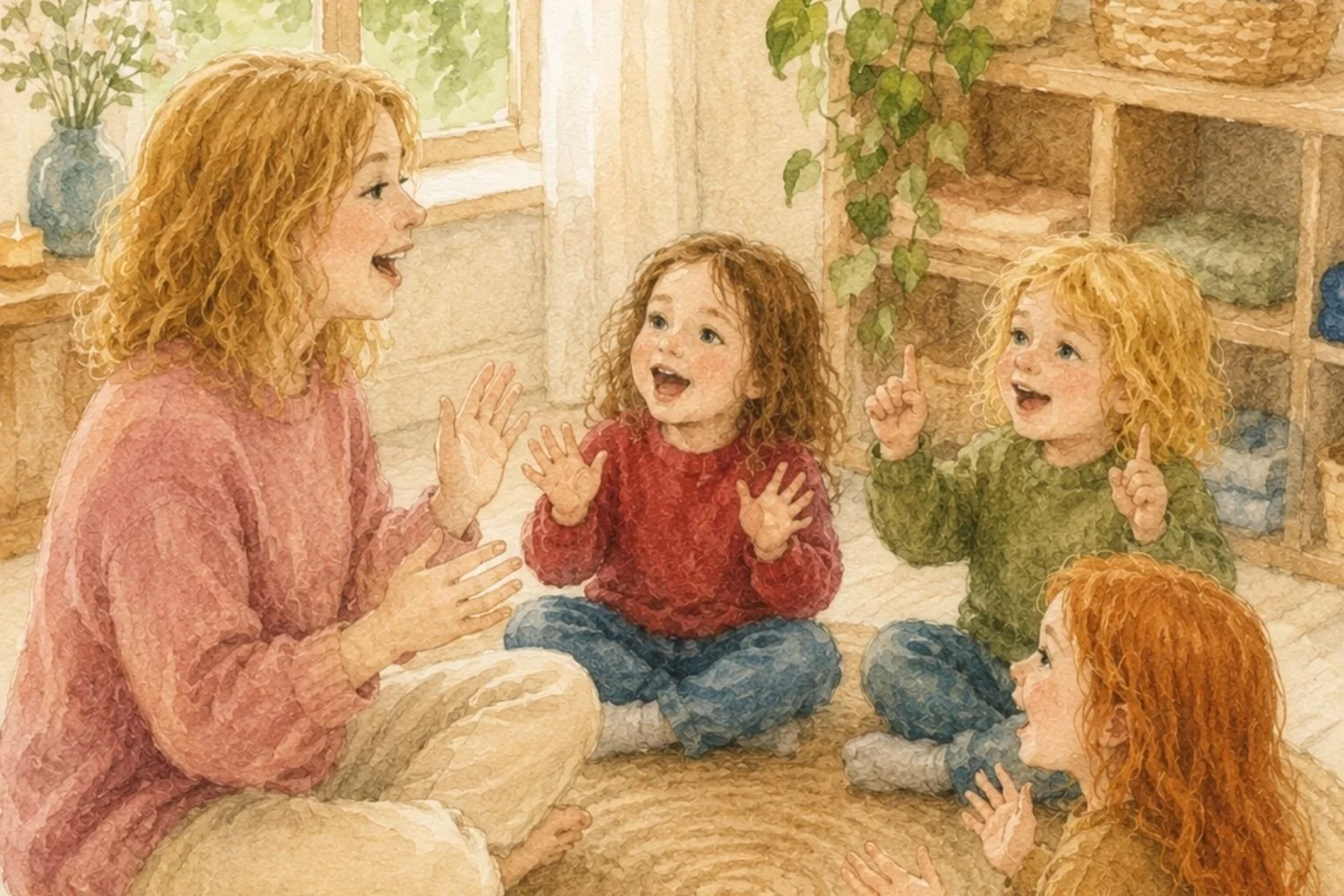
My approach to circle time or, as some call it, morning circle is much the same as my approach to many things with young children. I use a familiar, repetitive rhythm, while leaving plenty of room for the children’s own ideas and creative input.
Our circle time usually lasts around 15–20 minutes, depending on how enthusiastic the children are that day.
After tidying our space together with my Tidy Up Teamwork song, we gather and settle while I sing my Circle Time song. The familiar song helps signal that one part of our day is finishing and another is about to begin.
For more ideas on using either of these songs, or any of my other transition songs, you can explore my free resource, Your Guide to Using Marla’s Songs.
Over time, the repetition creates a rhythm the children come to know. They know roughly how long circle time will last, that there will be familiar songs and actions, that they will have opportunities to choose songs themselves, and that there may also be a surprise new song or story.
We always finish with a short story told with simple props.
My Circle Time Rhythm
I generally follow the same loose structure:
We begin with a Good Morning song.
The next song is always the same familiar body-parts song. I find this familiarity helps the children settle into the activity and know what comes next.
We sing a few seasonal songs — perhaps about summer, spring, rain, wind or Christmas, depending on the time of year.
Then I invite the children to choose songs themselves. Some immediately announce their favorites, while quieter children may prefer to be asked individually.
I might then suggest a few songs myself, perhaps connected to something we've been talking about or exploring together.
Finally, I tell the children we'll sing one more song before our story.
The children can then lie down and get comfortable while I arrange the story props.
I begin every story with the same little melody: “Once upon a time, was it here or was it there?”
And when the story is finished, I always sing the words: “Now my tale is done.”
That familiar ending signals that circle time has finished and it's time for the children to move on to the next part of their day.
Learning & Skills Developed During Circle Time
Through singing, movement, repetition, conversation and storytelling, educators can intentionally incorporate experiences that support a range of learning outcomes.
A well-planned circle time offers opportunities to support and observe learning across many developmental areas. The examples below may also help educators identify links to the learning outcomes or developmental frameworks used within their own setting.
Circle time is a short group activity that supports children in my care:
Develop language & communication, self-regulation, a sense of identity & confidence
Develop social relationships & feel part of the group
Develop fine and gross motor coordination, as well as brain development
Learn new songs and stories
Learn counting, left & right, seasonal flow, alphabet, animal sounds
How to Create a Flow Through the Songs
While guiding the songs that we sing, I try to create a flow in topics as if the subject matter in the lyrics is telling a bit of a story as we move through the songs.
For example, someone might’ve suggested a horse song or a vehicle song; so, I ask the children, “where should we go?” or I suggest a destination that offers another song, eg. Bakery, pizza shop, Old McDonalds Farm, and then we might choose another vehicle or horse song for the ‘return trip’, so to speak.
Certain songs naturally string together effortlessly like ‘Where is Thumbkin’ flows into ‘Open, shut them’ because our fingers need a stretch after the exercise during Thumbkin.
Or, ‘Heads, shoulders, knees and toes’ flows into ‘Row, row, row your boat’ because we’re already sitting in that position, which then flows into going fishing in our boats, so we sing ‘One, two, three, four, five, once I caught a fish alive’.
Which Songs to Sing
The songs I sing with the children are those that I’ve gathered throughout my lifetime, as both a child and adult; old nursery rhymes, mother goose, preschool, playgroup etc.
What you choose to sing will naturally be your choice and should also be guided by the children’s interests and developmental stage.
There are also some songs I choose not to sing with children simply because they don’t sit well with me. For example, I don’t sing Three Blind Mice because of its violent storyline, or Rain, Rain, Go Away because we live in a region where rain is welcomed. These are simply my individual preferences, and you will naturally develop your own.
Many children love vehicle songs, food songs, animal songs, weather songs and clapping songs. Wherever possible, I like to include actions with the songs, giving children another way to participate while supporting movement and coordination.
Below is a table of songs that can help develop particular skills, either through the lyrics or, more particularly, through the accompanying actions:
| Song | Learning & Marla's Tip |
|---|---|
| Where Is Thumbkin Actions |
Develops: Fine motor coordination, concentration & finger isolation. Marla's Tip: I show the children how they can use Thumbkin to gently hold their other fingers down. |
| Hot Cross Buns Actions |
Develops: Crossing the midline, bilateral coordination & rhythm. Marla's Tip: I say, “We're going to put crosses on our claps.” We sit cross-legged and alternate between clapping our legs with crossed arms and uncrossed arms. |
| 1, 2, 3, 4, 5, Once I Caught a Fish Alive Lyrics |
Develops: Counting, number sequence, right & left awareness. Marla's Tip: At the end, I touch each child's little finger on their right hand and tell them this is their right side, and that the other side is called their left. |
| Rainbow Song Lyrics |
Develops: Colour recognition, sequencing & counting. Marla's Tip: As we sing the colours, I count them on my fingers. Afterwards, we count the seven fingers/colours together. |
| A, B, C Lyrics |
Develops: Alphabet sequence, rhythm & coordination. Marla's Tip: We alternate between clapping our hands and our crossed legs as we sing. |
| Old MacDonald Had a Farm Lyrics |
Develops: Language, memory & animal sound recognition. Marla's Tip: Before we start, I suggest everyone thinks of an animal to choose when it's their turn. |
Which Stories to Tell
Many of the stories I tell during circle time are connected to the seasons. For example, I might tell the Ukrainian folktale The Mitten during winter, or a story about a caterpillar emerging from its cocoon as spring arrives.
Seasonal stories can help draw children’s attention to the changing world around them and naturally lead into conversations about what they are experiencing — keeping warm in winter, planting seeds in spring, or noticing other seasonal changes.
Other stories are woven throughout the year simply for enjoyment. I choose stories that are short enough to hold the interest of even the youngest children in my group — sometimes as young as two. Edward Lear’s The Owl and the Pussycat is one favourite.
I like to tell these stories using simple props, which I gather beforehand. For The Owl and the Pussycat, for example, I use:
A small hand carved wooden boat
A needle felted cat (sitting)
A hand sewn felt owl
A blue cloth for the sea
A pastel yellow or orange cloth for the sand & hill
A hand sewn turkey (I created the pattern for this story but previously used a knitted rooster)
A knitted pig
One of my rings (placed on the pig’s snout and then onto the cat’s tail)
A wooden tree
A dolls pillow (under the cloth for the hill)
I usually tell the same story repeatedly for around three weeks, giving the children time to become deeply familiar with it. One of the lovely things I notice is that the story then often finds its way into their own play. Children may gather the same props and begin acting out the story themselves, often remembering many of the words and sequences without any prompting from me.
For me, this is one of the wonderful things about repetition: something first experienced together during circle time gradually becomes something the children can take ownership of and recreate for themselves.
Programming & Planning
At the beginning of the year, I like to plan which seasonal stories I might tell at particular times, linking them with the changing seasons or other events throughout the year. Other stories can then be woven into the program around terms, holidays, children’s interests and the learning we are exploring together.
I generally introduce a new story with the beginning of a new term or season. Because the children become familiar with this rhythm, they often begin to anticipate the arrival of a new story and are excited to discover what it will be.
There is no single right way to create circle time. This is simply the rhythm that has evolved in my own work with children over many years. I hope some of these ideas inspire you to create a circle time that feels natural for you and the children in your care.
With a little structure, plenty of repetition, and room for children to bring their own ideas, circle time can become a familiar part of the day that children genuinely look forward to.
Happy Singing,
Marla
Looking for a transition song to support your circle time?
Explore Marla's songs for group routines, transitions and everyday moments with children.
Want some practical guidance on using songs with children?
My free guide shares simple ideas for introducing songs, using repetition, and gently weaving them into the rhythm of your day.
