How to Help a Toddler with Transitions
Gentle ways to help young children move from one part of their day to the next
What a transition feels like to a young child
Children seem to live in a dreamy world where they explore their impressions from the ‘real’ world within that safe space that is their own. It’s like a little bubble and seems to be a feeling world much of the time, not so much a thinking world like the adult world often is. Think of that child’s play like the ‘work’ of the child, where they busy themselves learning in the most fun way possible.
Now imagine a young child deeply immersed in their play, exploring and learning as they do, when an adult comes along with a different idea of what the child should be doing at that point in time. The adult tries to get the child up and away from their play to do something entirely different. It’s not surprising that adults are often met with resistance at this point, regardless of what the next activity is.
Begin with connection
The most effective way to reach a child in their play bubble is to meet them there, rather than trying to pull them out. A happy little song can be the bridge that offers adults a way into the child’s world, and in turn, the child is offered a gentler way out and into the activity that the adult chooses with the song. Think of the melody as the pathway into the feeling world, and the subject matter of the song becomes the signpost directing children towards the next activity. The song allows you to connect with the child and when they acknowledge that connection as they look up at you, you meet their presence with a loving smile. And unless you need to dress them, you don’t need to get into the child’s personal space to connect with a song, just nearby.
Give the next moment a familiar cue
Once the child hears you begin singing, they already know roughly what’s coming, and that familiarity and predictability is genuinely calming, easing them through the transition.
Depending on the situation, no other words may be necessary. You can continue to sing the song gently and when the child looks up at you, indicating they’ve heard you and are ready to connect, you smile. Then, you either continue singing, or you reaffirm what the intended activity is by saying in a kind, gentle voice something like, “Let’s wash up for lunch,” because that’s the moment for a verbal prompt, if any at all.
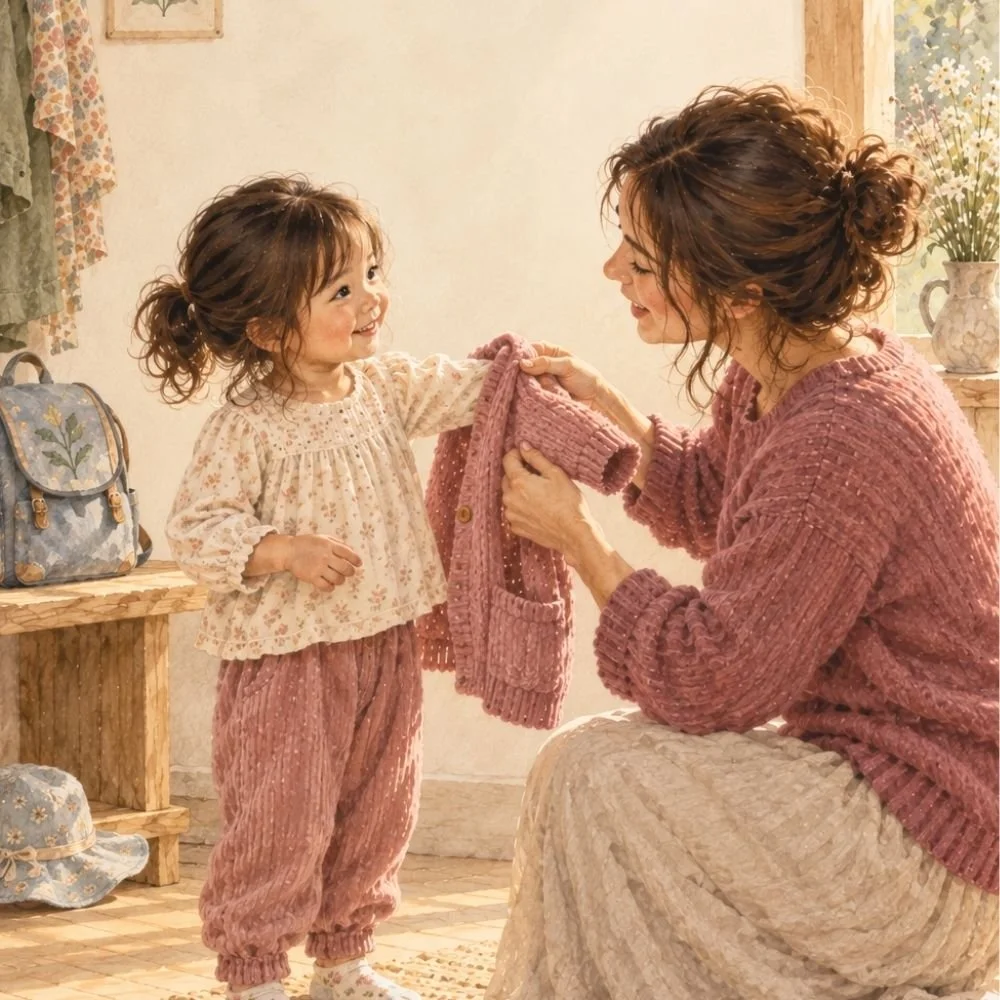
For example, I softly sing my Getting Dressed song while kneeling in front of a child as I hold open a sock or a sleeve. I don’t announce what’s happening. They simply respond to the melody by stopping whatever they were doing, looking up at me, and then joining in the actions that accompany the song. Remember that children are easily distracted once they’ve surfaced from their play. I repeat this song, changing the words to suit each garment as we go: “little foot”, “little arm”, head, button, zipper, until the child is dressed.
When you sing, children hear a familiar voice, but even more importantly, they experience the relationship between you, and they receive much more than instructions. They hear warmth, presence, encouragement, and joy. Even when we have busy days, singing reminds children that we are doing this together, and that feeling of togetherness and connection is often what makes cooperation possible.
Let the child join in at their own pace
Children take their first cues from you, not from the words. They watch what you’re doing — your actions, your expression — before they start joining in themselves. Some children join in with the actions first and the words later; others pick up the words quickly and the actions take a little longer. Both are completely normal, and there’s no need to prompt or correct either one. The song will do its work if you simply keep singing it, the same way, each time the moment comes around.
Please don’t worry or feel disappointed if children don't join in immediately. Joining in is not the first stage of learning. Listening comes first, while children are taking everything in. They are absorbing the melody, learning the rhythm, watching your face and noticing your enjoyment. All of this is participation. The singing usually comes later and that's perfectly normal. Some children will sing after a few days and others may take several weeks. Quiet children sometimes surprise us by suddenly singing every word one day. They haven't been doing nothing, they've been learning all along. Just keep singing lovingly.
Make room for different kinds of transitions
Remember that different situations will require a slightly different approach from you, but all songs should be sung with a happy heart. The children will feel it.
For example, while the Getting Dressed song is sung in a soft, gentle voice for an intimate indoors transition between you and one other child, the Wait at the Gate song is sung with a much louder and livelier feel. Outdoor settings will require more volume to be heard, plus you may be singing to numerous children, and certain situations call for a more fun and lively approach. The children detect that, and they in turn will find the fun in the activity. For example, children in my care often like to turn the waiting into a password game, whereby I must guess the password before we can all pass through the gate. Occasionally we don’t have time, so I happily say in a singing voice, “We can’t play passwords today! And off we go!” The children are content with that and are generally happy as long as I’m happy, and we continue on through the gate together.
Alternatively, when it’s a longer transition like tidying up, I use two songs to keep the children’s enthusiasm high. I alternate my Tidy-Up Teamwork song with my Tidy-Up Crane song, during which we pretend to be worksite cranes, picking up blocks and other toys and putting them away into a box or basket. Prior to this, I always give the children five minutes notice, “Children, in 5 minutes we’re going to do Teamwork Time.” Children love this routine and make sound effects at the end of each round as we sing together.
What to try tomorrow
Begin with one song. Use it consistently and trust repetition. Just choose one recurring moment. You don't need to change every routine at once or use every song from day one. A simple way to begin is to pick one or two moments in your day that currently feel the most rushed or difficult and bring in just one song there. You don’t need a perfect singing voice. Just keep your voice light, happy, and a little playful as you sing. Repeat the song throughout the duration of the routine or transition, giving the child an opportunity to associate the melody with the action.
There’s no need to change the rhythm or routines you’ve already established with your children. The rhythm that already exists in your home or your care setting is the one that matters most. The songs simply support it.
Sing the same song every day for a week or two. Don't worry if children don't join in immediately as the familiarity is doing its work quietly. One day you'll notice them humming the tune before you begin. That's when the rhythm has become part of their day.
Would you like to listen to a preview of one of my songs that I mentioned earlier, Getting Dressed?
Added benefit for the adult
Singing will make you feel good too. Singing can be wonderfully restorative. As you sing, your body relaxes, you enjoy the moment, you feel the connection. You’ll connect with yourself as well as the children in your life. And somehow, it makes us all feel lighter and happier.
Happy singing,
Marla
